Customer cases

À lire aussi
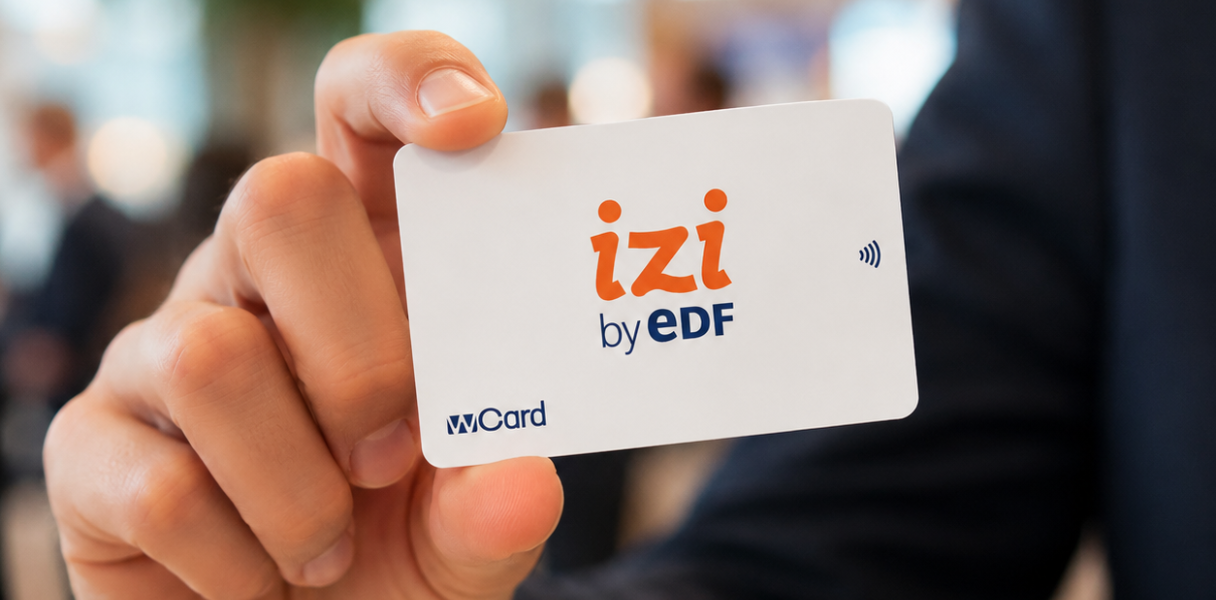
How Izi Confort (Izi by EDF), a specialist in heating and air conditioning installation, equipped its branch managers to streamline information sharing.
.png)
Marketplace, Waalaxy integration, offline AI scanner, badge folders, multilingual app... WEMET is opening up to your ecosystem this month. Discover all the new features and our tips for getting the most out of them.
In a legal sector where first impressions and trust are crucial, traditional communication tools must evolve to meet the requirements of modernity. BCTG Avocats has undertaken a significant digital transformation by replacing its paper media with NFC technology. This article analyzes how the adoption of WEMET solutions allowed this renowned firm to streamline its internal processes while promoting its brand image among its clients.

The business card remains the preferred tool for initiating a business relationship in the legal world. It acts as a tangible extension of a lawyer's expertise.
For a firm, the business card is not just a rectangular piece of paper. It embodies the visual identity and the professionalism of the structure. In a competitive environment where business law requires responsiveness and precision, this communication tool must reflect the excellence of the service offered. It is often the first physical element left to potential customers or colleagues during courthouse hearings or business meetings.
Beyond the simple transmission of coordinates, the card plays a crucial role in anchoring memories. A careful design, whether minimalist on a white background or more daring with touches of blue or gold, conveys the values of the firm. However, the persistence of the paper format raises questions of relevance. The transition to technological support is not only aimed at modernizing the image, but at transforming this passive object into an active lever for commercial development and professional networking.
Before its digital transition, the BCTG Avocats law firm was running up against the logistical and financial limitations inherent in managing a large number of physical cards.
Managing paper business cards represents a major logistical challenge for a dynamic firm. Employee turnover, internal promotions or the change of a telephone number systematically trigger a heavy reprinting process.
This planned obsolescence causes considerable waste. It is estimated that nearly 88% of paper business cards end up in the trash within a week of being exchanged. For a large firm, this means thousands of cards thrown away annually, representing a direct financial cost. Printing delays also create latency periods during which a lawyer may find himself without an up-to-date communication tool, which impairs his ability to canvass immediately.
The absence of a centralized management communication media often lead to a disparity in the image returned. With orders placed punctually, it becomes difficult to guarantee perfect uniformity of the graphic charter (respect for the logo, color codes such as institutional black or blue, and the font).
This fragmentation also makes it difficult to update cross-cutting information, such as the website address. Without a single management platform, the firm risks seeing heterogeneous card models circulate, thus confusing the perception of the employer brand and the image of rigor expected of a business law firm.
The use of static paper cards has a direct impact on operational efficiency. Manually entering the information received is time consuming and error-prone. A lawyer or legal expert wastes precious time transcribing data into their CRM, instead of focusing on the added value of the exchange.
Presenting a damaged paper card also sends a negative signal, contradicting the image of excellence that a leading firm wishes to project. The absence of a digital solution also deprives the firm of valuable analytical data on the networking activity of its teams, preventing any accurate measurement of the return on investment of professional events.
To meet these challenges, BCTG Avocats has opted for the WEMET solution. We offer a complete solution for digitizing professional exchanges, transforming the business card into a real digital hub that centralizes management and modernizes each interaction.

The adoption of the NFC technology using WEMET cards marks a break with traditional methods. This technology allows the instant sharing of data by simply reconciling the card to the smartphone, without requiring the installation of a third-party application.
To guarantee universal compatibility, our cards incorporate a double technological system: an NFC chip and a dynamic QR code. This hybrid approach ensures that each lawyer can transmit their contact form (vCard), social media links and access to the firm's site in a fraction of a second, regardless of the client's or colleague's equipment.
The solution includes a platform dedicated to managing exchanges. We offer customization options advances in the card and a customizable digital interface according to its precise graphic charter: banner, profile photo, institutional colors.
Our platform also integrates lead management features efficient. Lawyers can not only share their information, but also capture that of their interlocutors instantly to synchronize it with the firm's CRM tools.
Here is a comparison of the capabilities between the old system and the new solution:
This digitization makes it possible to integrate direct links to legal publications or appointments, considerably enriching the initial interaction.
The integration of connected cards has generated measurable results both in terms of brand image and in terms of the efficiency of the firm's internal processes.
The adoption of WEMET cards has enabled BCTG Avocats to strengthen its position as an innovative firm. By replacing thousands of paper cards, the firm is making its CSR approach a reality. We stand out for our strong ecological commitment, by offering cards made from sustainable materials such as upcycled wood Or the Recycled PVC, with French manufacturing in Toulouse that reduces the carbon footprint.
On the administrative level, the centralization of management via a single interface has drastically reduced the mental and financial burden. Support teams can now change an employee's title or contact information in a few clicks, ensuring that each card is always up to date with no additional printing costs.
In the field, lawyers report increased fluidity during professional events. The “friction” associated with the exchange of coordinates has disappeared. The technological gesture sparks curiosity and engages conversation, creating a memorable first impression.
Operational benefits include:
This modernization turns each encounter into a qualified opportunity, strengthening commercial development in sectors such as real estate law or business law.
The experience of BCTG Avocats shows that the digitization of communication media is an essential strategic lever. The transition to the NFC business card meets the imperatives of sustainability, economic efficiency and commercial performance.
We support this transformation with an approach adapted to the needs of the legal professions. Our economic model without a subscription mandatory and our personalized support for law firms guarantee a smooth deployment. By adopting this technology, firms are not content with modernizing their image: they are optimizing each interaction to transform a simple contact into a lasting client relationship.