Technology
À lire aussi

What are the functionalities of an NFC business card and how can they transform your professional exchanges?
.png)
Marketplace, Waalaxy integration, offline AI scanner, badge folders, multilingual app... WEMET is opening up to your ecosystem this month. Discover all the new features and our tips for getting the most out of them.
Despite the digitalization of communication, the business card remains a pillar of professional networking. Much more than a simple rectangle of paper, it acts as a true ambassador for your company and brand image at events, trade shows, or business meetings. It is often the first tangible item your contact keeps, and potentially the last thing they will look at before deciding to reach out to you again.

In a competitive B2B environment, simply handing out a business card is no longer enough. The challenge now lies in the ability to transform this traditional object into a measurable performance driver.
How do you move from a simple exchange of contact details to a real acquisition strategy? The answer lies in optimizing the medium, controlling its distribution, and, above all, precisely analyzing the data it can generate.
Whether printed on high-end paper or connected via NFC business card, the business card must now meet objectives of profitability and relational efficiency.
For a business card to convert a meeting into an opportunity, its design should leave nothing to chance. It must accurately reflect your market positioning while respecting the standards of your industry.
The design of your card is the primary vector of emotion. It must align perfectly with your brand guidelines to ensure immediate visual consistency. Using your logo, brand colors, and legible fonts is a must.
An overloaded card is often counterproductive: white (or empty) space allows the content to “breathe” and guides the eye to what is essential.
We recommend prioritizing visual information. The logo should capture attention, followed by your name and job title. Using the front for a strong visual identity and the back for technical details is a proven standard practice.
For innovative businesses, a minimalist design with a well-integrated QR code suggests modernity and efficiency.
Touch is a powerful sense for memory. The quality of the material says a lot about the quality of your services. Paper that is too thin (less than 300g) can suggest a lack of budget or professionalism, while a rigid or textured stock inspires confidence and durability.
Finishing options help you stand out:
Beyond aesthetics, the ethical dimension of the material has become a key decision factor for many partners.
At WEMET, we favor a rigorous eco-responsible approach with cards made locally in France, using sustainable or upcycled materials such as wood or Recycled PVC. Choosing a sustainable medium sends an implicit message about your corporate values.
The primary objective remains making contact. Information should be up to date, legible, and engaging. Avoid overwhelming the recipient with superfluous data.
Here are the essential elements and their recommended hierarchy:
Adding a subtle “Call to Action” (CTA), such as a QR code leading to an appointment calendar or a portfolio, transforms a static card into a gateway to your digital ecosystem.
Having a perfect business card does not guarantee success if its delivery is not handled with tact and strategy. Exchanging cards is a professional ritual that sets the tone for a new relationship.
The timing of the delivery is just as important as the card itself. Handing out your card on the fly at the start of a conversation can be perceived as aggressive or disinterested. Best practice is to wait until the end of the exchange, or for the moment when the other person expresses a desire to continue the relationship.
Gestures count: present the card in the correct orientation, hold it by the corners so as not to obscure the information, and above all, take the time to read the card you receive in return. It is a mark of respect that values your contact.
If you are using a smart card, the gesture of “tapping” the card on a prospect's phone creates a “wow” effect that breaks the ice and makes the moment memorable.
A business card shouldn't be an end in itself, but the start of a follow-up process. Too often, cards received end up at the bottom of a drawer or are lost before ever being added to a CRM. Technology offers concrete solutions to prevent this loss.
Our WEMET lead capture feature radically transforms this dynamic. During the exchange, you don't just share your information; the scan feature also allows you to instantly capture your contact's data.
This information is digitized and structured immediately, facilitating post-event follow-up by eliminating tedious manual entry and ensuring no lead is forgotten due to a paper card being lost.
Your card should be part of a comprehensive communication strategy, acting as the bridge between the physical world and your online presence.
The adage “what gets measured gets managed” applies perfectly to networking. With traditional paper cards, calculating ROI (Return on Investment) is complex, if not impossible.
How many cards handed out ended up in the trash? How many actually generated a visit to your site?
The transition to connected solutions makes it possible to lift this veil.
Qualitative impact is measured by the reactions of your contacts and the perceived image of your company. A premium or tech-forward card immediately positions your company as innovative and quality-focused.
Although difficult to quantify, this impact results in:
A business card that sparks curiosity or admiration is an effective icebreaker that creates a favorable environment for business negotiations.
For performance-driven companies, switching to data-driven analysis is essential.
This is where the connected card pulls ahead of traditional paper.
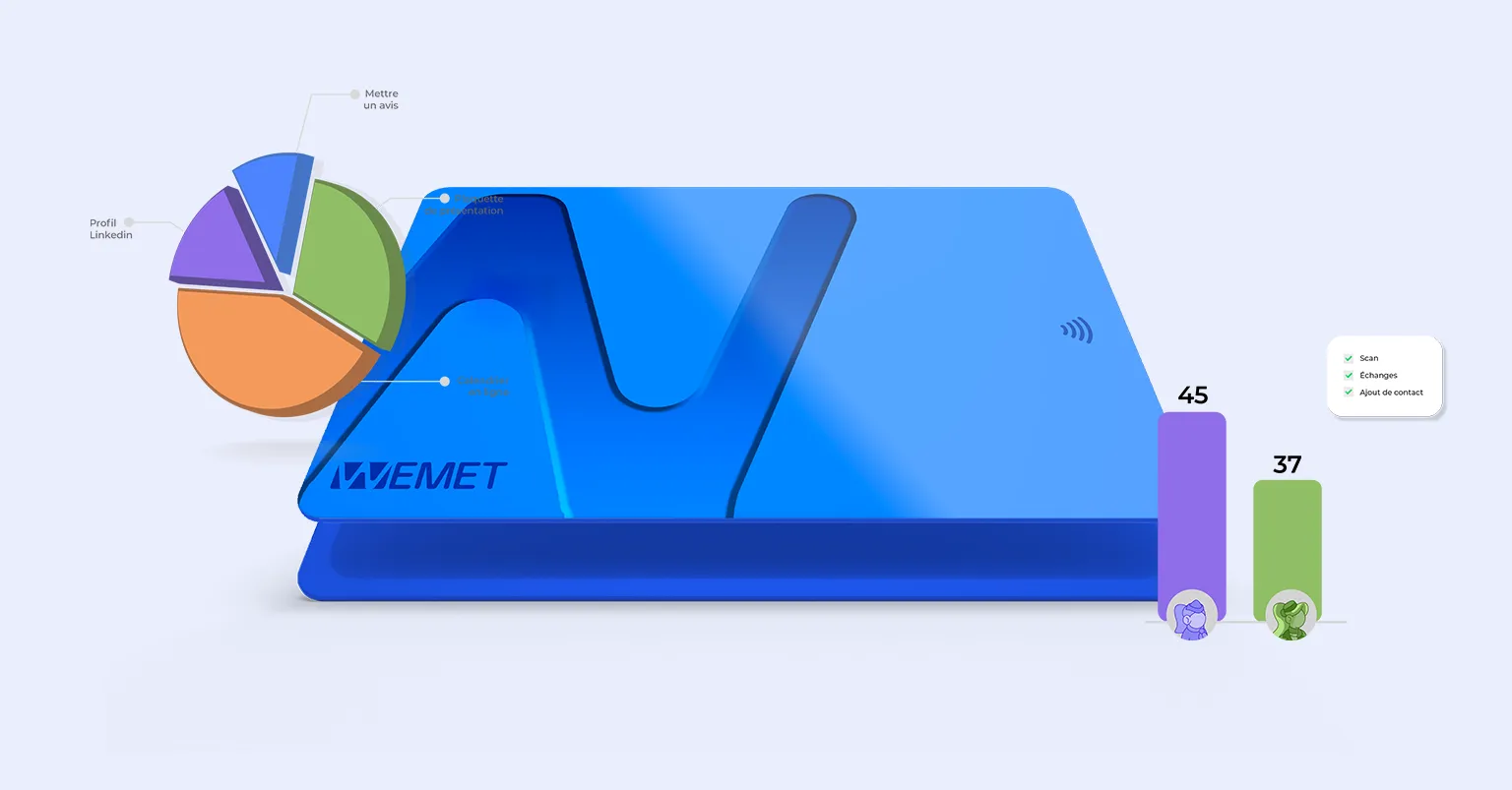
We provide advanced statistics via a dedicated dashboard, allowing you to precisely analyze how your teams are using their cards. You can track:
Unlike standard QR code tracking services, which cost between €10 and €60 per month, scan, save, and click statistics are included natively in your WEMET subscription.
This data makes it possible to refine your sales pitch and identify which team members are the most active in networking.
The transition to digital technology is not just a trend; it is a major functional evolution. The WEMET NFC business card acts as a physical key that unlocks a rich and dynamic digital profile.
Key features include:
Creating and using business cards requires constant attention to avoid missteps that could damage your credibility.
The standard format (85 x 55 mm) remains a safe bet because it fits perfectly into any wallet. However, depending on your industry, variations may be appropriate:
Options like QR codes should be integrated aesthetically, without disrupting the visual harmony of the card.
The cost of a business card varies significantly based on technical choices. To optimize your budget:
Some mistakes can ruin the intended effect:
The business card remains an essential investment for any professional. Whether it is made of textured paper or equipped with an NFC chip, it makes the encounter tangible and initiates a relationship of trust.
The future belongs to hybrid solutions that combine the elegance of a physical object with the power of digital data. By choosing measurable and sustainable tools like the ones we offer at WEMET, you transform an administrative expense into a real strategic asset for your business development, ensuring that every handshake really counts.
WEMET est une worktech toulousaine qui vise à révolutionner les échanges professionnels. En 2020, son cofondateur Samuel Dassa part d’un constat :
les cartes de visite papiers ne sont pas pratiques et plus adaptées au monde du travail actuel.
Ainsi, est née la carte de visite connectée : la WeCard. Grâce à la technologie NFC, que l’on retrouve dans le paiement sans contact par exemple, elle vous permet d’échanger un large panel d’informations. La valeur clé chez WEMET c’est l’expérience utilisateur. Il était donc important pour nous de faire évoluer notre produit en innovant au quotidien mais également de vous garantir un produit qui évolue avec et tout au long de vos projets professionnels.

Première société à proposer la carte de visite connectée sur le marché français, WEMET compte aujourd’hui plus de 20 000 entreprises équipées, 200 000 utilisateurs de WeCards et plus de 10 collaborateurs.
The choice depends on your goals: for mass distribution at a low cost, conventional paper printing through online printers is suitable. For a lasting impact, an innovative image, and ROI monitoring, NFC-connected business cards (such as those from WEMET) are recommended, as they allow for real-time updates and CRM integration.
Start by defining the key elements of your visual identity (logo, colors, typography) and ensure they are consistent with your website. Choose a clean design that highlights your role and your unique value proposition, and don't hesitate to use materials or finishes that reflect your industry (creative, luxury, tech).
For 500 standard paper cards, expect to pay between €30 and €80 depending on the paper weight and finishes. For connected cards, the business model is different: it is a one-time purchase per employee (between €30 and €100 per sustainable card), sometimes accompanied by a subscription for advanced software services, which is often more cost-effective in the long run by eliminating the need for reprints.
Absolutely. They remain the fastest and most universal tool for exchanging contact details during in-person meetings. Its modern version (connected/NFC) bridges the digital gap by allowing for the instant transfer of data to a smartphone, combining the ease of a physical exchange with the efficiency of digital technology.