Customer cases
À lire aussi
How Izi Confort (Izi by EDF), a specialist in heating and air conditioning installation, equipped its branch managers to streamline information sharing.
.png)
Marketplace, Waalaxy integration, offline AI scanner, badge folders, multilingual app... WEMET is opening up to your ecosystem this month. Discover all the new features and our tips for getting the most out of them.
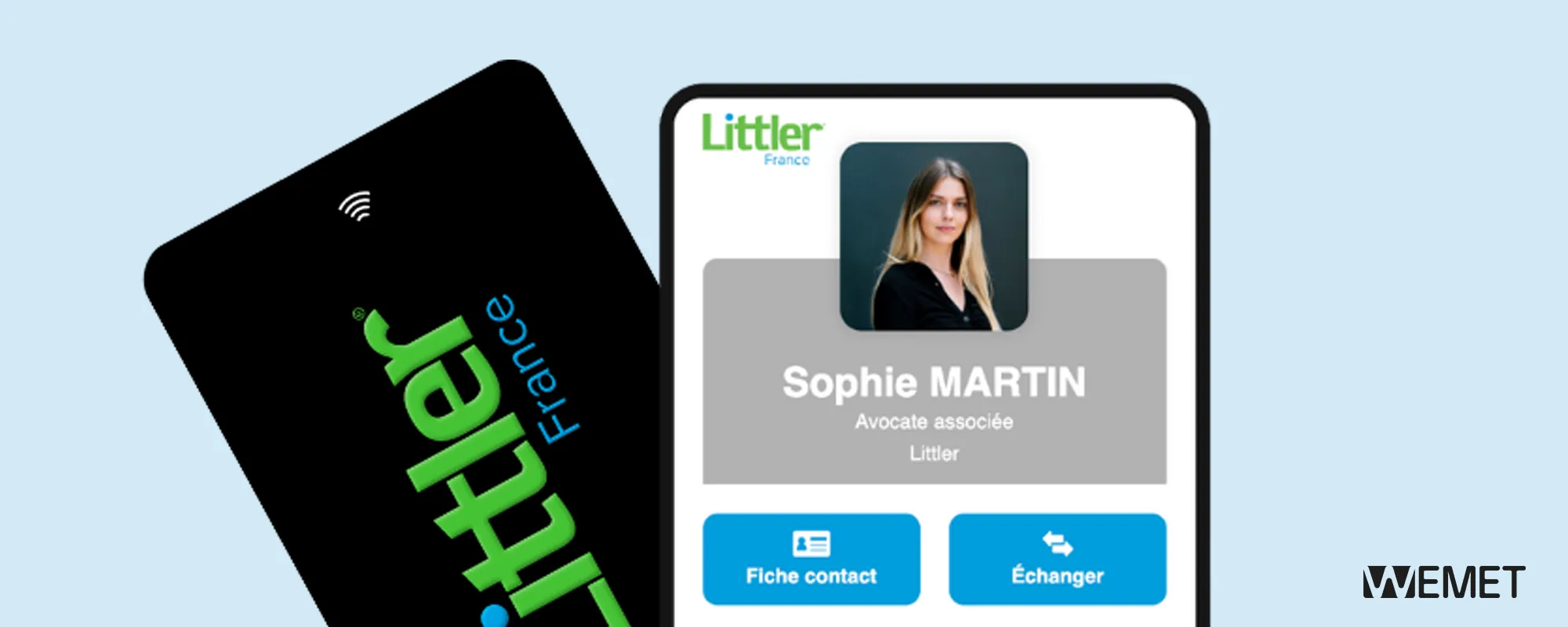
The adoption of digital technology is redefining professional interactions within the legal sector, transforming the methods of prospecting and retaining. The law firm Littler France, a reference in employment law, illustrates this change by integrating the connected lawyer business card into its event strategy to maximize the impact of its meetings. This article analyzes how this technological transition meets the performance and ethical requirements specific to modern lawyers.

The digitalization of communication media represents a major evolution for the legal profession, where precision and responsiveness are essential vectors of trust. The connected business card is not limited to a simple digital transposition of paper format. It constitutes a dynamic and evolving interface between the legal professional and his interlocutor. Unlike static printed media, this tool allows information to be updated in real time (change of address, new expertise, change of direct line), ensuring that the data transmitted is always accurate.
From a technical point of view, the superiority of this device lies in its ability to transmit rich and structured data instantly. To ensure total interoperability during exchanges, WEMET equips its cards with a NFC chip (Near Field Communication) of the latest generation and a dynamic QR code, guaranteeing a universal compatibility with all smartphones on the market, whether they are on iOS or Android. This dual technology makes it possible to overcome material constraints: if the interlocutor's telephone is not equipped with NFC, scanning the QR code ensures immediate transmission of the contact form (vCard).
For a lawyer, this tool becomes a differentiator. It allows you to integrate not only traditional contact details, but also direct links to legal publications, the firm's website, or online appointment booking. By centralizing these access points, the connected card structures the first level of customer relationships, immediately projecting an image of technological competence and organizational efficiency.
The exclusive use of paper card presents measurable structural inefficiencies that penalize the commercial development of firms. Industry statistics indicate that nearly 88% of paper business cards distributed are discarded or lost in less than a week, without ever being recorded in a database. For a lawyer participating in a conference or seminar, this represents a drastic loss of opportunities.
The post-event processing process is also time consuming and error-prone. Manually entering information from a paper card into a digital directory or CRM takes an average of 2 to 3 minutes per contact. Out of a volume of 50 meetings during a legal event, this represents more than two hours of administrative work with low added value. The risk of input errors (typing errors in the email or telephone number) is estimated at around 8%, which directly compromises the ability to recover and the effectiveness of the customer follow-up. Finally, the ecological impact of recurrent printing, estimated at several kilograms of paper and ink per lawyer over a career, contradicts the CSR policies increasingly adopted by modern firms.
In an increasingly competitive legal market,branding of the office is a discriminating factor. The first impression is formed in less than 7 seconds, and the tool used to exchange contact information actively contributes to this perception. A lawyer who uses a digital solution implicitly demonstrates his ability to adapt to technological developments, a quality sought after by client companies who expect agility and modernity from their legal advice.
Professional presence no longer stops at the physical encounter. It extends immediately into the digital sphere. The connected card makes it possible to instantly direct the prospect to thedigital ecosystem of the firm (LinkedIn profile, blog articles, Legal 500 or Chambers awards). This continuity between the real and the virtual reinforces the authority of the lawyer. By offering a fluid and innovative user experience from the first contact, the professional anchors his personal brand in the mind of his interlocutor, thus distinguishing himself from colleagues who have remained on traditional media.
For the legal profession, the adoption of any new communication tool must imperatively respect strict ethical rules and data security standards. La smart lawyer business card must comply with the requirements of the National Internal Regulations (RIN) concerning personal advertising and solicitation, by ensuring that the information shared is “true, respectful of professional secrecy and implemented with dignity and delicacy”.
Data security is also a critical issue, especially with regard to the GDPR. Unlike third-party contact management applications that can vacuum address books, professional solutions like those used by major firms guarantee data sovereignty. The information is hosted on secure servers (often ISO 27001 or HDS certified), and the transfer via NFC or QR code is encrypted. The lawyer keeps a total control over the data he shares and can deactivate your card remotely in case of loss, a feature that is impossible with paper format. This control of the flow of information reassures clients that the firm is serious about confidentiality, the cornerstone of the lawyer-client relationship.
Littler France, specialized in social and labour law, operates in an environment where networking is intense and strategic. The firm's lawyers regularly participate in HR conferences, legal symposiums and business summits where they meet HR directors, legal directors and managers. The density of these events means multiplying interactions over a very short period of time.
The need identified by the firm was twofold: reduce friction when exchanging contact details and maximize the retention rate of post-event contacts. The distribution of hundreds of paper cards was logistically cumbersome and inefficient in terms of conversion. A solution was needed that could withstand the steady pace of meetings while conveying the image of excellence and innovation specific to a leading firm. The need to be able to share specific content (legal newsletters, social alerts) directly when making contact was also a decisive criterion for enriching the relationship from the first seconds.
To meet these requirements, the firm deployed WEMET connected cards. The strength of this solution lies in its technical simplicity of execution: WEMET offers instant sharing without contact or application required for the recipient. Concretely, the lawyer approaches his card to the smartphone of his interlocutor, and a notification appears immediately, opening the complete digital profile.
The user manual for lawyers is designed to be intuitive and fast:
This absence of technological barriers (no app for the customer to download) is crucial. It guarantees an acceptance rate of nearly 100% during exchanges, streamlining the dialogue without annoying technical interruptions.
The deployment of this technology has generated quantifiable results for Littler France teams.
Efficiency is reflected in a significant increase in the number of qualified leads recovered per event. Memorization is reinforced by the visual and interactive aspect of the digital profile, which makes it possible to display the lawyer's photo, logo and expertise. Finally, the innovative image projected positions the firm as a modern player, aligned with the challenges of digital transformation of its own clients. The ecological aspect (zero paper waste) also reinforces the employer brand and the coherence with the firm's CSR values.
The real power of the connected card lies in its ability to transform an informal meeting into data that can be used for the development of the firm. Unlike the paper card, which creates a break in the flow of information, the digital solution ensures data continuity.
WEMET offers lead tracking tools and CRM integration that make it possible to automate post-event management. When a lawyer uses the “Wemet Connect” function to retrieve the contact details of his interlocutor, this information does not remain isolated in a telephone. They are centralized in a management dashboard (the Wemet Manager) which offers an overview of the firm's networking activity.
Key features include:
This automation drastically reduces administrative time and eliminates information loss, ensuring that no qualified prospect is forgotten due to lack of follow-up.
In the lawyer-client relationship, trust is built by the accumulation of signs of professionalism. The connected card acts as a personal “mini-site” that reassures and informs the customer well before the first formal consultation.
By scanning the card, the client accesses a controlled and chartered environment in the colors of the firm. There, he can consult essential reinsurance elements:
This transparency and this immediate accessibility reinforce customer reception. The prospect does not leave with a simple piece of paper, but with a Portal for complete access to lawyer skills. This creates a perception of availability and transparency, two cardinal values for establishing a lasting relationship of trust. The quality of the materials used for the physical cards (upcycled wood, metal, recycled PVC) also contributes to the sensory experience and reinforces the perceived standing of the firm.
Littler France's experience shows that the connected lawyer business card goes beyond the status of a simple technological gadget to become a driver of commercial performance and image. By solving the problems of loss of contacts, automating the integration of data into CRMs, and modernizing customer interaction, this tool pragmatically addresses the challenges of current legal networking.
For law firms, the adoption of this technology is no longer a futuristic option but an operational necessity to remain competitive and in line with the expectations of a digitized clientele. The transition to “contactless” and “paperless” is part of a global approach of efficiency and responsibility.
WEMET supports more than 20,000 companies in their professional digitalization, offering proven expertise to secure and optimize this transition. By choosing a robust, secure and made in France solution, lawyers are investing in a tool that values their expertise while simplifying their daily lives, transforming each handshake into a sustainable opportunity.
WEMET est une worktech toulousaine qui vise à révolutionner les échanges professionnels. En 2020, son cofondateur Samuel Dassa part d’un constat :
les cartes de visite papiers ne sont pas pratiques et plus adaptées au monde du travail actuel.
Ainsi, est née la carte de visite connectée : la WeCard. Grâce à la technologie NFC, que l’on retrouve dans le paiement sans contact par exemple, elle vous permet d’échanger un large panel d’informations. La valeur clé chez WEMET c’est l’expérience utilisateur. Il était donc important pour nous de faire évoluer notre produit en innovant au quotidien mais également de vous garantir un produit qui évolue avec et tout au long de vos projets professionnels.

Première société à proposer la carte de visite connectée sur le marché français, WEMET compte aujourd’hui plus de 20 000 entreprises équipées, 200 000 utilisateurs de WeCards et plus de 10 collaborateurs.