Marketing and sales
.png)
À lire aussi
The printing price is just the tip of the iceberg: 7 hidden costs that drive up the real bill for your business cards.
.png)
Marketplace, Waalaxy integration, offline AI scanner, badge folders, multilingual app... WEMET is opening up to your ecosystem this month. Discover all the new features and our tips for getting the most out of them.
Reprinting your business cards costs more than you think: it accounts for 22% of the total budget, and it is the easiest expense to eliminate.

In theory, you order business cards once. In practice, according to the 2026 WEMET Barometer (surveying 225 French companies), reprints alone account for 22% of the total cost of a business card. This is the largest expense category, even higher than the initial printing itself.
The problem is that no one sees it coming. A single reprint seems like a trifle: just one more order, a few dozen euros. But when repeated employee after employee, year after year, it becomes the heaviest and most avoidable cost in your entire sales toolkit.
A paper business card has a theoretical lifespan of several years. In reality, it is often obsolete long before it is fully distributed. According to the Barometer, 31% of printed cards become obsolete before they are fully used , meaning a third of your stock ends up in the trash or a drawer.
Why? Because a paper business card freezes information at a specific moment in time, in a company where nothing stays the same for long.
According to the 225 companies surveyed for the 2026 WEMET Barometer, here is the exact breakdown of the causes for reprints:
Promotions, internal mobility, HR title changes... every move leads to a new order. In a mid-sized company, these movements are constant; it’s not an isolated incident, but a continuous flow that fuels a queue of reprints all year round.
A typo, a transposed number, an incorrect job title: when ordering dozens of cards at once, errors often go unnoticed until delivery. The result: the entire batch needs to be reprinted, or worse, distributed as is, which takes a heavy toll on your professional image.
The 2026 WEMET Barometer provides precise figures on frequency: a company with 50 employees reprints an average of 1.8 times per year, per employee. Over 3 years, this represents up to €4,800 in avoidable reprints for this company alone, for this single item.
Extrapolating this ratio to other team sizes (indicative estimate, based on constant assumptions):
The price of the printing itself is just the tip of the iceberg. Every reprint also triggers:
For a complete overview of the administrative time lost in managing business cards, see Price of a connected NFC business card for companies: the 2026 real cost.
The root cause of the problem is that paper business cards lock information onto the physical medium itself. The only way to eliminate reprints is to decouple the information from the medium, which is what a digital business carddoes.
With WeCard:
In practical terms, your "reprint" costs drop to €0 once you've made the switch, regardless of how many job title, address, or contact detail changes occur throughout the year.
The calculation depends on your team size, turnover rate, and current ordering frequency. Use the calculator to get your personalized actual cost in under 2 minutes:
Reprints are just one expense among many: see also the real cost of all your sales prospecting tools.
According to the 2026 WEMET Barometer, reprints account for 22% of the total cost of a corporate business card, which is approximately €96 per employee over 3 years for a typical company of 50 people.
On average 1.8 times per year per employee, mainly due to job changes (35% of cases) and errors discovered after delivery (22% of cases).
Switch to a digital business card (NFC or QR code) where the displayed information can be updated online without ever needing to change the physical card.
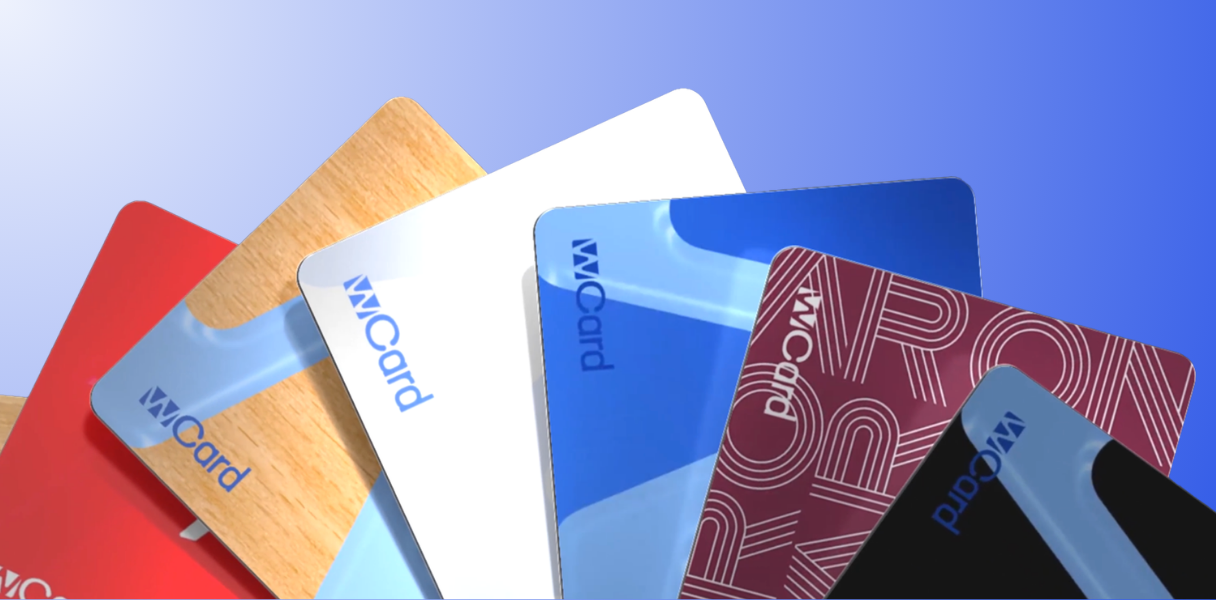
Yes, that is the concept behind the WeCard digital business card: the physical card stays the same, while the information displayed upon scanning is updated for free at any time.
WEMET est une worktech toulousaine qui vise à révolutionner les échanges professionnels. En 2020, son cofondateur Samuel Dassa part d’un constat :
les cartes de visite papiers ne sont pas pratiques et plus adaptées au monde du travail actuel.
Ainsi, est née la carte de visite connectée : la WeCard. Grâce à la technologie NFC, que l’on retrouve dans le paiement sans contact par exemple, elle vous permet d’échanger un large panel d’informations. La valeur clé chez WEMET c’est l’expérience utilisateur. Il était donc important pour nous de faire évoluer notre produit en innovant au quotidien mais également de vous garantir un produit qui évolue avec et tout au long de vos projets professionnels.

Première société à proposer la carte de visite connectée sur le marché français, WEMET compte aujourd’hui plus de 20 000 entreprises équipées, 200 000 utilisateurs de WeCards et plus de 10 collaborateurs.