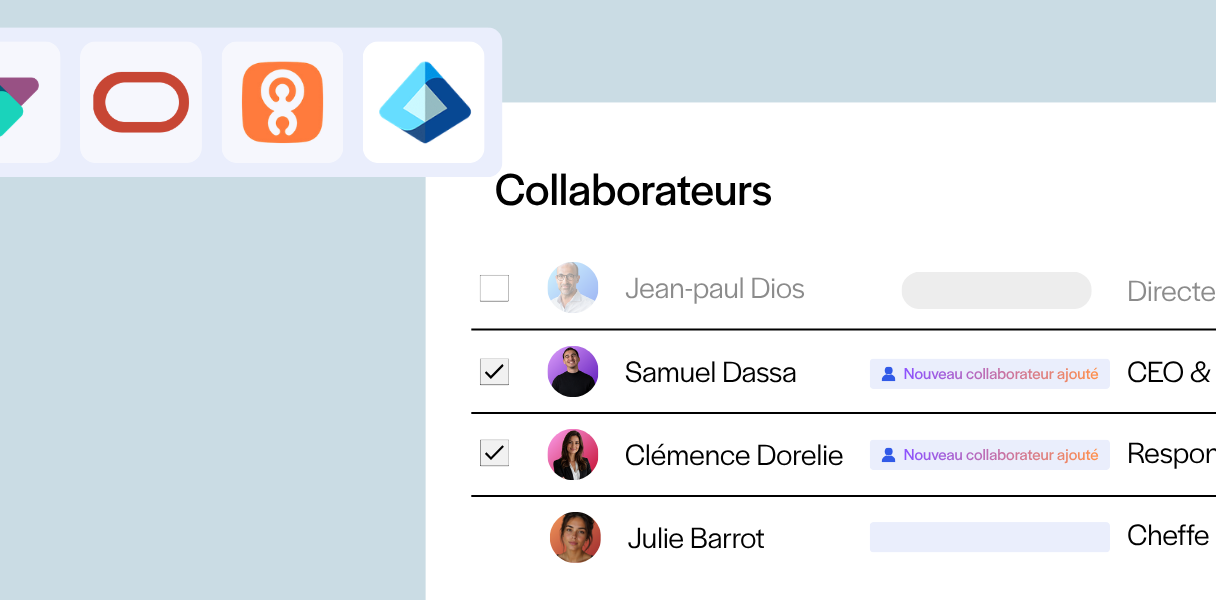
Ordering NFC business cards for an entire team takes ten minutes. Getting them actually used, connecting them to your CRM, and turning them into measurable contacts requires a bit more method.
Printing, reprints, errors, updates, admin time… The true cost of a corporate business card goes far beyond the printing price. Discover the figures from the 2026 WEMET Barometer — and calculate your potential savings.
Ordering NFC business cards for an entire team takes ten minutes. Getting them actually used, connecting them to your CRM, and turning them into measurable contacts requires a bit more method.
temps de lecture
November 20, 2026
Estelle Prieto
November 20, 2026
In most teams, adoption is rapid. But there are often one or two people who never update their profile, leave their card in their wallet, or keep their contacts on their phone rather than in the CRM.
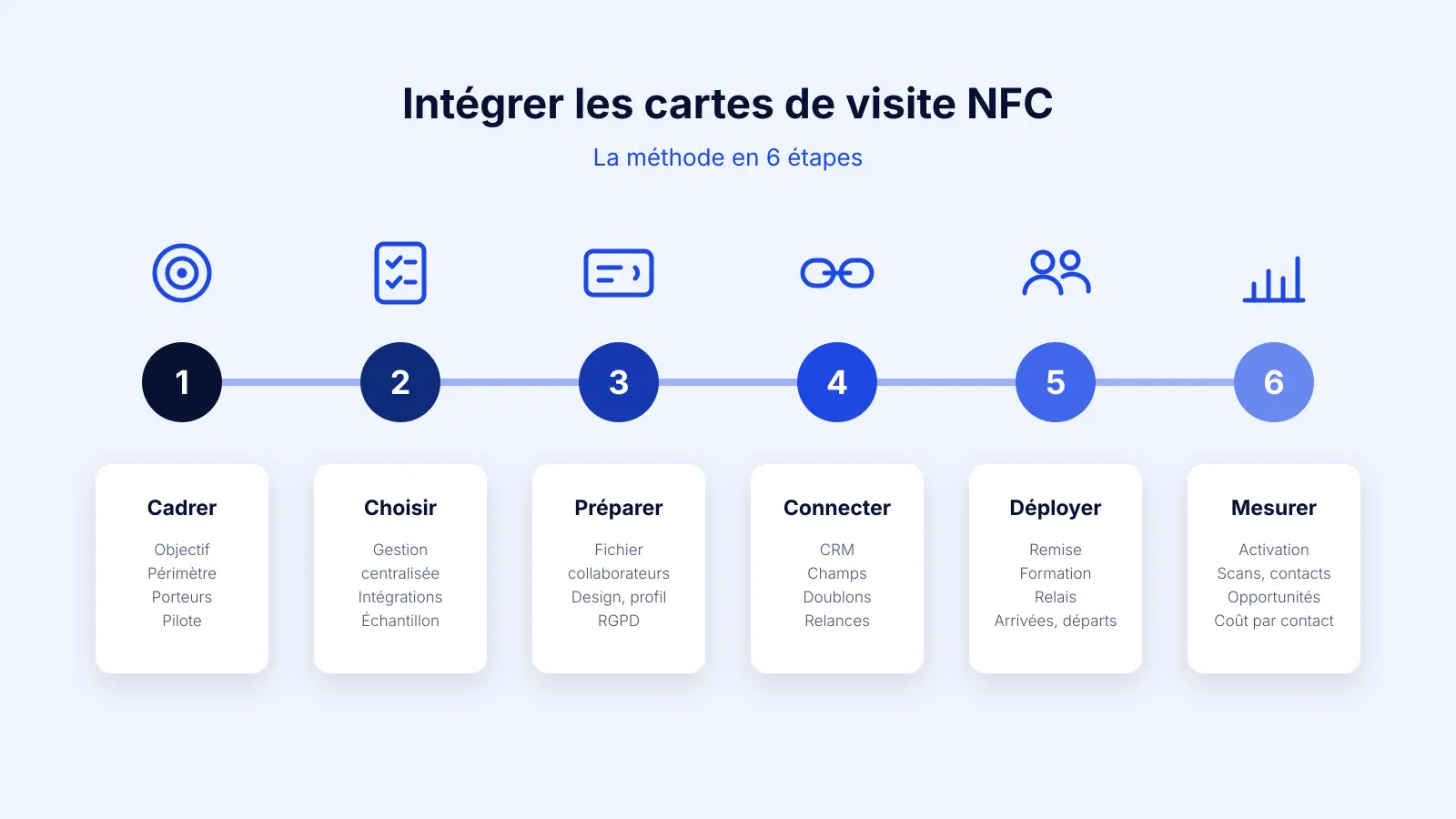
This guide outlines the implementation in six steps, from scoping to management, highlighting the most common pitfalls encountered in the field.
Why switch to NFC cards at the company level
An NFC business card shares a digital profile with a simple tap on a smartphone. For an individual, it's convenient. For a company, it's a change in methodology: exchanging contact details becomes actionable data.
Information that is always up to date. A change in job title, phone number, or address can be updated online, with no need for reprinting.
Consistent brand image. All employees present the same branding, the same messaging, and the same links.
Contacts that no longer get lost. Exchanges made at a trade show or during a meeting can be fed directly into the CRM.
Measurable results. Scans, profile visits, and collected contacts can be tracked by employee and by event.
These benefits don't come from the card itself. They come from how it is integrated into your processes.
Step 1: Define the project scope
Before choosing a provider, write down what you expect from the cards. A one-page brief is enough, but it must answer four questions.
What is the main objective?Generating leads at trade shows, modernizing brand image, reducing printing costs, standardizing profiles… The objective determines the metrics to track later on.
For whom? Start with the profiles that exchange the most contact information: field sales reps, executives, account managers, recruiters. The rest of the company can follow in a second phase.
Who is leading the project? Usually a duo: marketing (branding, profile content) and sales or HR (employee lists, onboarding and offboarding). If a CRM integration is planned, involve the person who manages the tool from the very beginning.
What is the timeline? Align the rollout with a key event: a trade show, a sales seminar, or a product launch. This provides a deadline and an initial opportunity to measure results.
Tip: launch a pilot with 5 to 10 people for a few weeks. You will validate the design, profile content, and contact flow before ordering for everyone.
Step 2: Choose the right solution
All NFC cards look the same once in your hand. The difference lies in the platform that manages them. For corporate use, check these criteria.
Un administrateur peut-il créer, modifier et désactiver les profils de toute l'équipe depuis un seul espace ?
Charte imposée
Peut-on verrouiller le logo, les couleurs et certains champs pour garder une image cohérente ?
Intégrations
La solution se connecte-t-elle à votre CRM (HubSpot, Salesforce…) et à vos outils de prospection ?
Collecte de contacts
Le prospect peut-il laisser ses coordonnées en retour, et où arrivent-elles ?
Statistiques
Voit-on les scans et les contacts par collaborateur, par équipe, par période ?
Compatibilité
La carte fonctionne-t-elle sur iPhone et Android sans application à installer, avec un QR code en secours ?
Réaffectation
Que devient la carte quand un collaborateur quitte l'entreprise ? Peut-on la réattribuer ?
Données et RGPD
Où sont hébergées les données, et qui en est responsable ?
Tarifs au volume
Le prix unitaire baisse-t-il avec la quantité, et quel abonnement faut-il pour les fonctions équipe ?
Request a sample before committing: holding the card, testing it on several phones, and seeing how the profile looks is worth more than any brochure. At WEMET, you can receive a free sample.
Step 3: Prepare the data and branding guidelines
This is the most underestimated step, and the one that saves the most time later on.
The employee file. Gather the following in a spreadsheet: first name, last name, job title, department, email, phone number, office address, LinkedIn profile link, and photo. Most platforms accept CSV imports; a clean file will save you from having to make dozens of individual corrections.
The card design. Decide on the material (PVC, metal, wood, recycled materials), whether it will be double-sided, and which elements will be personalized for each employee. Keep the card simple: its purpose is to encourage people to scan it, not to say everything at once.
The profile template. Define a common framework:
the mandatory fields and those that each person can fill out;
links common to the entire company (website, appointment booking, brochure, presentation video);
locked elements, such as the logo and brand colors;
a clear call to action: "Save contact," "Book an appointment," "Leave my details."
The GDPR framework. If the cards collect prospect contact information, prepare the privacy notice and consent forms, and add this data processing activity to your register. Your DPO or legal counsel can validate the setup.
Testez avant d'équiper toute l'équipe
Recevez un échantillon gratuit de la WeCard, sans engagement.
An isolated NFC card is just a gadget. When connected to your tools, it becomes an entry point for your sales pipeline. The typical workflow looks like this:
The prospect scans the card and opens the employee's profile.
They save the contact and leave their own details via the profile form.
The contact is automatically added to the CRM, assigned to the right salesperson, and tagged with the source (trade show, meeting, event).
A follow-up sequence begins: thank-you email, LinkedIn invitation, and meeting request.
To set up this workflow:
Connect your CRM. A native integration is ideal; otherwise, an automation tool like Make or Zapier can bridge the gap.
Map your fields. Decide which form fields populate which CRM properties, and how the contact source is recorded.
Avoid duplicates. Set a deduplication rule, typically based on the email address.
Link your prospecting. Contacts gathered in the field can feed into your LinkedIn campaigns or email campaigns.
The list of connectors available with WEMET can be found on the Integrations.
Vous équipez toute une équipe ?
Gestion centralisée des profils, intégration à votre CRM, tarifs dégressifs selon le volume : recevez une proposition adaptée à votre entreprise.
Technology is rarely the problem. Adoption is. An employee who doesn't know when or how to pull out their card will leave it in their wallet.
Make the handover a moment to remember. Distribute the cards during a team meeting or seminar, not via internal mail. It’s the perfect opportunity to demonstrate the process and answer questions.
Train in 15 minutes. A short session is enough to cover:
how to present the card ("I'm sharing my contact info with you, just tap your phone");
where to place the card on the other person's phone, and when to use the QR code;
how to update your profile;
where to find collected contacts.
Appoint ambassadors. One or two enthusiastic team members can share best practices and report any challenges.
Plan for common scenarios. New hire: profile created and card ordered as part of the onboarding process. Departure: profile deactivated or card reassigned. Job change: updated online, no reprinting required.
Highlight early results. After the first trade show, share the number of contacts collected. Nothing is more convincing than a figure achieved by a colleague.
Step 6: Measure and manage
Refer back to the goal set in step 1 and track the metrics that address it.
Indicateur
Ce qu'il vous dit
Taux d'activation
Part des collaborateurs qui ont complété leur profil et utilisé leur carte au moins une fois
Scans par collaborateur
Qui utilise sa carte, et qui a besoin d'un coup de pouce
Contacts collectés
Volume de leads récupérés, par personne, par équipe ou par événement
Taux de conversion du profil
Part des visites de profil qui aboutissent à un contact enregistré ou à un formulaire rempli
Opportunités issues des cartes
Dans le CRM, les affaires dont la source est une carte NFC
Coût par contact
Coût total des cartes et de l'abonnement divisé par le nombre de contacts collectés
Conduct an initial review one month after deployment, then after every major event. Adjust the profile accordingly: a call-to-action with few clicks, an unnecessary link, or a form that is too long can be fixed in minutes.
Common mistakes to avoid
Ordering for everyone at once, without a pilot group or field feedback.
Letting everyone fill out their profile on their own, without a common template: your brand image will quickly deteriorate.
Forgetting the CRM : contacts remain trapped in phones, making it impossible to measure your return on investment.
Failing to provide training : the card stays in the wallet.
Overlooking departures : a former employee whose profile is still active continues to receive contacts.
Frequently asked questions
How long does it take to deploy NFC cards in a company?
Allow a few weeks between the scoping, the pilot, and the general rollout. Card manufacturing is only part of the timeline; data preparation and training take just as long.
Do my contacts need to install an app?
No. Modern smartphones read NFC natively, and a QR code on the card takes over for the rest.
What happens when an employee leaves the company?
The administrator deactivates their profile or reassigns the card to another employee, depending on the chosen solution.
Can we keep paper cards in parallel?
Yes, during the transition. In practice, teams abandon them as soon as the NFC habit is formed.
Are NFC cards GDPR compliant?
Yes, provided you inform the people whose contact details you are collecting and obtain their consent when necessary.
Conclusion
Successfully integrating NFC business cards comes down to six steps: scoping, choosing, preparing, connecting, deploying, and measuring. The companies that get the most out of them are those that treat the card as a sales tool, not an accessory.