Marketing and sales
.png)
À lire aussi
The printing price is just the tip of the iceberg: 7 hidden costs that drive up the real bill for your business cards.
.png)
Marketplace, Waalaxy integration, offline AI scanner, badge folders, multilingual app... WEMET is opening up to your ecosystem this month. Discover all the new features and our tips for getting the most out of them.
Printing, reprints, errors, updates, admin time… The true cost of a corporate business card goes far beyond the printing price. Discover the figures from the 2026 WEMET Barometer — and calculate your potential savings.

You ordered your business cards. You looked at the printing price. You signed off. Case closed.
Except it isn't.
What you paid for is just the tip of the iceberg. Beneath the surface are the reprints, the errors caught too late, the job title updates, and the hours spent managing it all internally. And nobody is really tracking those costs.
WEMET decided to do just that. The result: the 2026 WEMET Barometer, a survey conducted among more than 225 respondents from French companies of all sizes. What we found will likely surprise you.
That’s the first number that hits home.
When you ask executives and HR managers how much their business cards cost, they almost all cite the printing rate. €0.15, €0.30, sometimes €0.50 per unit for high-end cards. Multiplied by 200 employees, that’s a budget. A line in a spreadsheet. And then you move on.
Except that 68% of the total cost comes from indirect expenses. Expenses that no one tracks. Expenses that accumulate silently, quarter after quarter.
So where is the money really going?
With 22% of the total cost, reprints are the number one hidden expense, and by far the most avoidable.
In practical terms, here is why your teams are reprinting:
This isn't bad luck. It's just how things work. In a company of 50 people, job changes, promotions, and reorganizations happen all the time. And every time, it means a new order, a new approval cycle, and new stock arriving three weeks later.
Key figure: a company with 50 employees reprints an average of 1.8 times per year per employee. Over 3 years, that adds up to €4,800 in... avoidable reprints.
This is the one nobody sees coming. Because it doesn't show up on an invoice. It disappears into the hours spent by assistants, office managers, and marketing managers who "handle it between meetings."
Our data is clear:
Ordering, supplier follow-ups, internal approvals, corrections, distribution, inventory management... These are zero-value-added tasks that tie up skilled staff. And when you calculate the cost of this time at an employee's actual hourly rate, the numbers quickly become significant.
This figure is perhaps the most telling finding from the Barometer.
Nearly 3 out of 4 companies have never calculated what their business cards actually cost them. They manage them on an ad-hoc basis, without a global overview, without tracking reprints, and without accounting for the time spent.
This isn't a criticism. It's a reality: the subject is perceived as trivial, so no one really pays attention to it. And that is exactly why costs accumulate without ever being questioned.
31% of printed cards become obsolete before they are fully used. A third of the stock ends up in the trash. Or in a drawer. Which amounts to the same thing.
To make this concrete, here is what it looks like for a team of 50 sales representatives over 3 years:
Savings: -86%, or €11,750 over 3 years.
This is not an optimistic projection. It is the average observed in our scenarios, based on conservative assumptions.
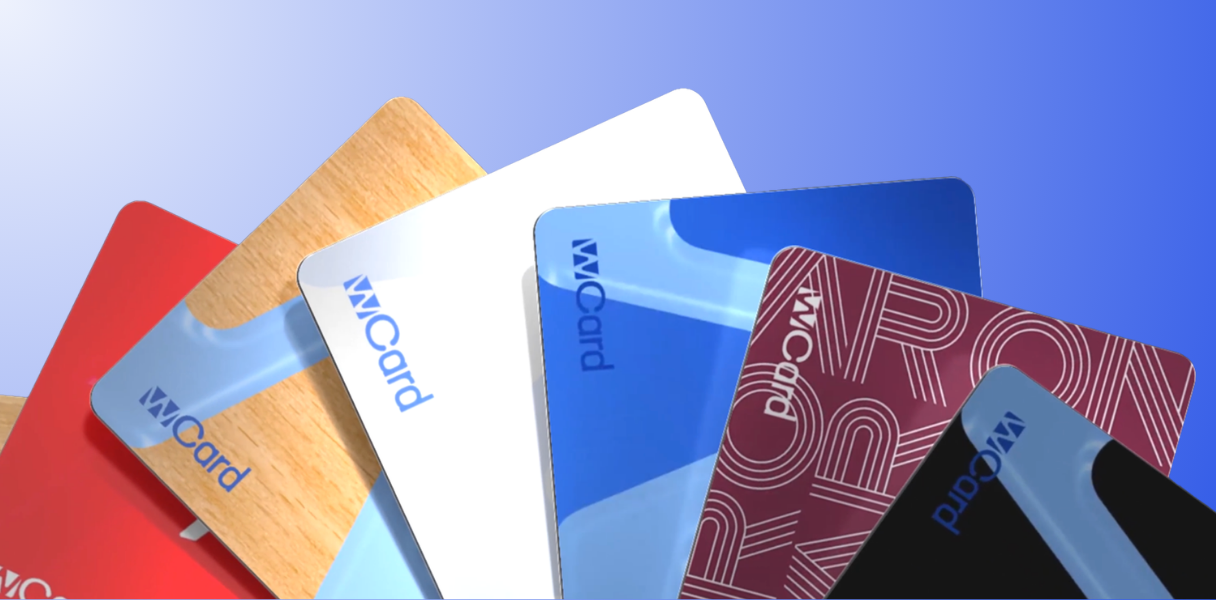
The smart business card, that is what WeCard does, based on a simple principle: separating the physical medium from the information it contains.
The NFC card or QR code you hand to someone doesn't change. What changes is what it displays when scanned.
The tangible result:
And as a bonus: every interaction is tracked. You know who scanned your card, when, and from which device. Sales data that paper cards could never offer you.
Among respondents who have already adopted a smart card solution, feedback converges on three points:
1. Management finally becomes centralized. No more scattered orders by department, no more ghost inventory in desk drawers. One interface, one team in charge, everyone up to date.
2. The ROI is visible from the first year. No need to wait 3 years to feel the difference. The first avoided reprint, the first job change handled without a new order—the savings are immediate.
3. Brand image is consistently coherent. No more business cards with the old logo sitting on a prospect's desk. No more employees handing out cards with outdated email addresses. Your brand stays polished, everywhere, all the time.
The answer depends on your company size, turnover rate, how often you reprint, and the time your team spends managing it all.
That’s why we built a free online calculator that does the math for you in under 2 minutes.
Enter your data—number of employees, order frequency, and annual reprints—to see your real 3-year cost, your potential savings with WeCard, and a figure you can present to your management team.
One-time purchase, no mandatory subscription. Unlimited updates included.
It takes 2 minutes. And it often changes how you look at a "small expense" you thought was under control.
This third of cards that are never used is not just a financial loss: it is also a key issue for responsible purchasing for companies committed to CSR initiatives. And business cards are just one item in your sales budget: discover the real cost of all your sales prospecting tools, lead scanning, enrichment, and email signatures to get the full bill for your sales toolkit.
Data from the 2026 WEMET Barometer, a survey of over 225 respondents from French companies. Simulation based on average assumptions; actual results will vary depending on internal practices.